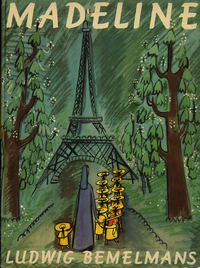
In an old house in Paris that was covered with vines
Lived twelve little girls in two straight lines
In two straight lines they broke their bread
And brushed their teeth and went to bed.
They left the house at half past nine
In two straight lines in rain or shine -
The smallest one was Madeline.
Ludwig Bemelmans, Madeline
My very first knowledge of Paris came from the Madeline books that an Austrian man wrote in English. Madeline lived in an elongated world that was extremely exotic to a South African child, with the Eiffel Tower stretching up to the sky, looming over the tall, arrow-shaped Miss Clavel who looked after all the little girls as they walked along streets lined with tall, thin trees.
It’s a very different Paris to the one inhabited by Marcel Proust (rhymes with ‘juiced’, roughly); full name Valentin Louis Georges Eugène Marcel Proust. The author of the marathon A la Recherche du Temps Perdu (In Search of Lost Time, or, as it used to be known, Remembrance of Things Past) lived from 1871 to 1922. He was a sickly child and a sickly man, but he wrote, in the last 13 or so years of his life, this monumental seven-volume book containing some 1.25 million words. It was the first novel to really openly speak of homosexuality.
Proust made use of the idea of ‘involuntary memory’ – memory that is evoked by ordinary everyday things. You know how you can be walking through a shopping mall, and suddenly you are overcome by a sense of happiness that you can’t explain? Then you realise that the intercom is playing a song that you heard while driving to the coast for your first visit to the beach. That’s involuntary memory.
And here’s where the Paris of Madeline meets the Paris of Proust. The most famous episode from A la Recherche du Temps Perdu involves involuntary memory:
She sent out for one of those short, plump little cakes called ’petites madeleines,’ which look as though they had been moulded in the fluted scallop of a pilgrim’s shell. And soon, mechanically, weary after a dull day with the prospect of a depressing morrow, I raised to my lips a spoonful of the tea in which I had soaked a morsel of the cake. No sooner had the warm liquid, and the crumbs with it, touched my palate than a shudder ran through my whole body, and I stopped, intent upon the extraordinary changes that were taking place. An exquisite pleasure had invaded my senses, but individual, detached, with no suggestion of its origin. And at once the vicissitudes of life had become indifferent to me, its disasters innocuous, its brevity illusory–this new sensation having had on me the effect which love has of filling me with a precious essence; or rather this essence was not in me, it was myself. I had ceased now to feel mediocre, accidental, mortal. Whence could it have come to me, this all-powerful joy? I was conscious that it was connected with the taste of tea and cake, but that it infinitely transcended those savours, could not, indeed, be of the same nature as theirs. Whence did it come? What did it signify? How could I seize upon and define it?
…
And suddenly the memory returns. The taste was that of the little crumb of madeleine which on Sunday mornings at Combray (because on those mornings I did not go out before church-time), when I went to say good day to her in her bedroom, my aunt Léonie used to give me, dipping it first in her own cup of real or of lime-flower tea.
Remembrance of Things Past: Swann’s Way, Marcel Proust
After that little taste of Proust’s writing, you might agree with Germaine Greer, who wrote in The Guardian newspaper on 8 November 2009: “If you haven't read Proust, don't worry. This lacuna in your cultural development you do not need to fill. On the other hand, if you have read all of A la Recherche du Temps Perdu, you should be very worried about yourself. As Proust very well knew, reading his work for as long as it takes is temps perdu, time wasted, time that would be better spent visiting a demented relative, meditating, walking the dog or learning ancient Greek.”
But you might want to make the little madeleines! This recipe comes from a great website for keen cooks, www.101cookbooks. You’ll need to buy a madeleine baking pan, so that you get the right scalloped-shell shape, but they’re easy enough to find.
1 1/2 sticks unsalted butter (6 ounces)
2 tablespoons softened unsalted butter (for greasing pan)
3/4 cups unbleached all-purpose flour (cake flour)
4 large eggs
a pinch fine-grain sea salt
2/3 cups sugar
zest of one large lemon
1 teaspoon vanilla extract
powdered sugar
a bit of extra flour for dusting baking pan
Preheat oven to 180 degrees (350 degrees Fahrenheit).
Melt the 1 1/2 sticks of butter in a small pot over medium heat until it's brown and gives off a deliciously nutty aroma, roughly 20 minutes. Strain (using a paper towel over a mesh strainer) - you want to leave the solids behind. Cool the butter to room temperature. By doing the butter first you can complete the rest of the steps while it is cooling.
While the melted butter is cooling, use the remaining 2 tablespoons of butter to grease the madeleine molds - get in there and make sure you get in all the ridges. Dust with flour and invert the pan tapping out any excess flour.
Put the eggs with the salt in the bowl of an electric mixer with a whisk attachment. Whip on high speed until thick - you are looking for the eggs to roughly double or triple in volume - approximately 3 minutes. Continuing to mix on high speed, slowly add the sugar in a steady stream. Whip for 2 minutes or until mixture is thick and ribbony. Now with a spatula fold in the lemon zest and vanilla (just until mixed).
Sprinkle the flour on top of the egg batter, and gently fold in. Now fold in the butter mixture, only stirring enough to bring everything together.
Spoon the batter into the molds, filling each mold 2/3 -3/4 full. I use a small cup filled with batter to keep things clean and manageable, it is easier than using a spoon.
Bake the madeleines for 12 - 14 minutes (7-10 minutes for smaller cookies), or until the edges of the madeleines are golden brown. Remove from oven and unmold immediately. Cool on racks and dust with powdered sugar.
Makes 2 -3 dozen regular madeleines.

No comments:
Post a Comment